FIELD NOTES — ENTRY NO. 06
This guide may contain affiliate links. If you buy through one, we may earn a small commission at no extra cost to you. As an Amazon Associate I earn from qualifying purchases. We only recommend the kinds of things we’d keep ourselves.
A cigar is a living thing, more or less. It was rolled in a humid place, and it wants to stay there. Leave one on the counter for a few days and it dries out, cracks and burns hot. Keep it too wet and it won’t stay lit.
A humidor is just a box that keeps the cigar where it was happy. Here’s how to set one up, keep it right, and know when something’s off.
The box
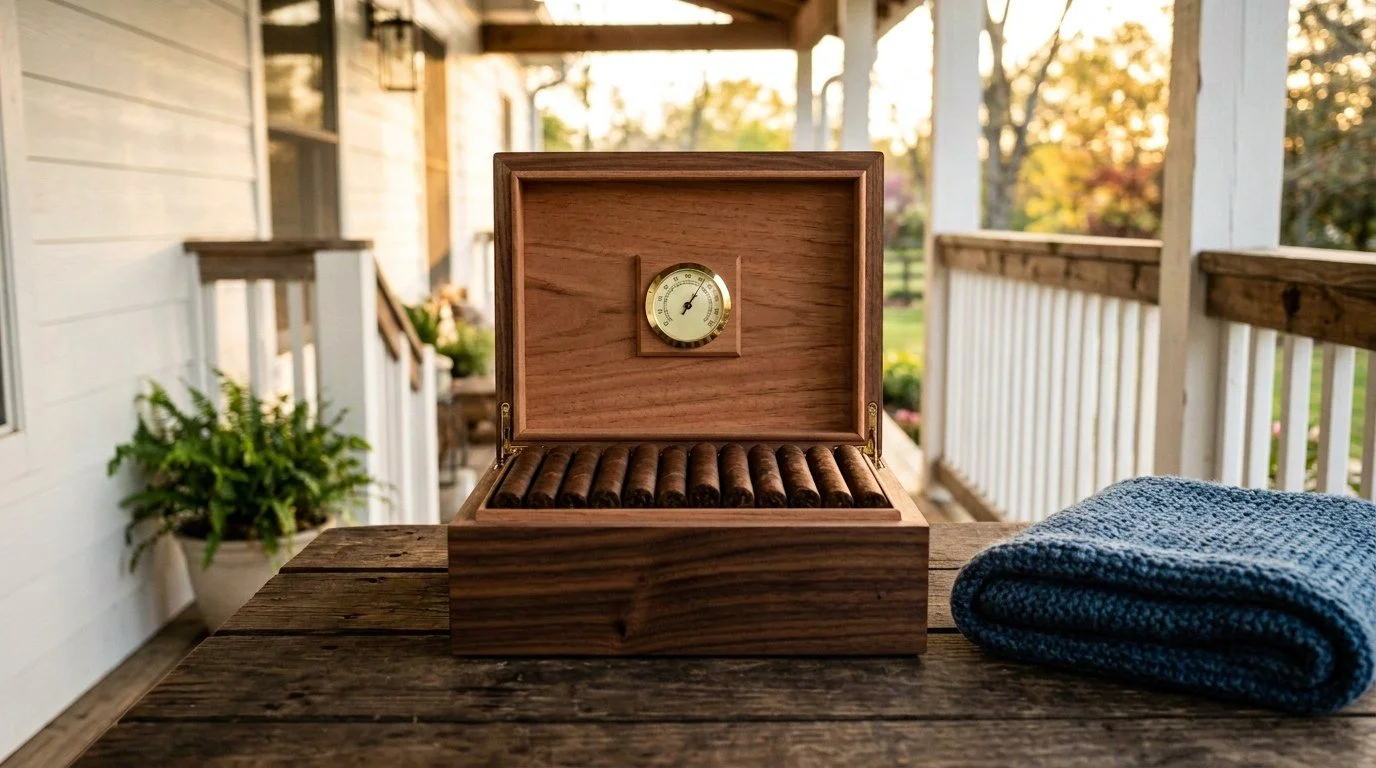
A good humidor does three things: it seals, it’s lined with Spanish cedar, and it shows you the humidity. Spanish cedar isn’t a true cedar at all. It’s a tropical hardwood from the mahogany family, chosen because it holds moisture well, resists mold and gives the cigars a faint, pleasant aroma.
To check the seal, close the lid on a dollar bill. If it slides out with no resistance, the seal is too loose to hold humidity.
The numbers
Aim for about 65 to 70 percent humidity and a room around 70°F. Old hands call it the “70/70 rule,” and it’s still a fine place to start. Many smokers settle a little lower, around 65 percent, for an easier draw and a steadier burn.
What matters most is that it stays steady. A humidor that swings up and down is harder on cigars than one that sits a point or two off target.
Seasoning a new humidor
Never put cigars into a brand-new humidor. Dry cedar will pull the moisture right out of them. Season it first.
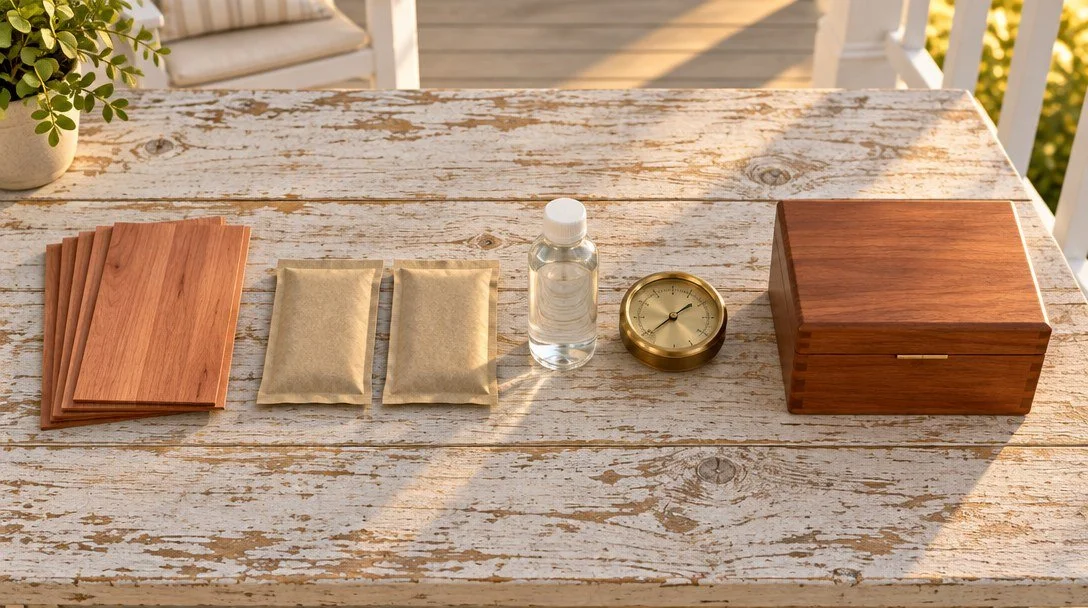
The simplest way is to set humidity packs made for seasoning (84 percent) inside, close the lid, and leave it alone for about 14 days. The old way also works: wipe the cedar lightly with a clean cloth dampened in distilled water, set a small dish of distilled water inside, close it up, and wait a day or two before adding cigars.
Don’t soak the wood, and never use tap water. Its minerals and chlorine have no business near your cigars.
Humidifying
Two-way humidity packs are the easy road. They add moisture when it’s dry and absorb it when it’s damp, with nothing to refill. A good rule of thumb is one large (size 60) pack for every 25 cigars your humidor holds.
If your humidor came with a foam or crystal humidifier, fill it with distilled water or humidor solution (a propylene glycol mix), never tap water, and check it every week or two.
Trusting your hygrometer
The little gauge in the lid is often wrong, especially the analog dial kind. Test it once a year with the salt test. Put a capful of table salt in a bottle cap, add a few drops of water until it’s damp like wet sand, and seal it in a zip-top bag with the hygrometer for about 12 hours. It should read 75 percent.
If it reads 72, it runs 3 points low, and you’ll know to add 3 to whatever it says. A good digital hygrometer is the best upgrade a humidor can get.
Heat and the tobacco beetle
Keep your humidor out of the sun, away from heaters and vents, and in a room that stays steady. Heat is the real enemy. Tobacco beetles can lie dormant in cigars and tend to hatch when it gets above about 72°F and 72 percent humidity.
If you ever find tiny pinholes in a wrapper, act fast: pull the cigars, bag them and freeze them to kill any eggs, then let them come back to room temperature slowly before they go back in the box.
Mold or plume?
Mold is fuzzy, often blue or green, tends to show up on the foot of the cigar, and smears when you wipe it. That’s a sign the humidity ran too high. Toss affected cigars, wipe the cedar and bring the humidity down.
A fine white powder that brushes off cleanly is something else, often called plume or bloom. When in doubt, it’s safer to throw it out.
Keeping it tidy
Don’t pack the box to the brim; air needs room to move. Rotate cigars every month or so, top to bottom and front to back. Keep flavored or whiskey-infused cigars in their own box or their own cellophane, because a humidor shares every aroma it holds. Cellophane can stay on; it still lets moisture through slowly.
Common Questions
What humidity should a humidor be?
About 65 to 70 percent. Start at 69 or 70 and adjust to taste. Lower makes for a slightly drier, easier burn; higher makes for a fuller, slower smoke.
How long do I season a new humidor?
About two weeks with seasoning packs, or a day or two with the distilled-water method. Wait until the hygrometer holds steady before adding cigars.
Can I use tap water in a humidor?
No. Use distilled water or a humidor solution. Tap water leaves mineral deposits and can encourage mold.
How long will cigars keep in a humidor?
Kept well, for years. Many smokers believe some cigars improve with a few months or more of rest. What ruins them is neglect, not time.
Do I need a humidor for just a few cigars?
For a few days, a zip-top bag with a small humidity pack will do. For anything longer, a small desktop humidor pays for itself in cigars you don’t have to throw away.
Cigars are for adults only. In the U.S., you must be 21 to buy tobacco products.
THE SOCIETY’S GIFTING NOTES
For the one who keeps a box.
TIER 1
Under $25
Two-way humidity packs that keep any humidor right, with nothing to refill.
TIER 2
$25 to $75
A slim, accurate digital gauge that tells the truth when the old dial won’t.
Our pick: Caliber V digital hygrometer
TIER 3
$75 and up
A glass-top desktop humidor with thick Spanish cedar and a digital hygrometer. Room for about 30 to 50 cigars, depending on size.
Our pick: Case Elegance Renzo glass-top humidor, or for a bigger collection, the Michelangelo humidor from 1st Class Humidors (holds 120)
