FIELD NOTES — ENTRY NO. 02
This guide may contain affiliate links. If you buy through one, we may earn a small commission at no extra cost to you. As an Amazon Associate I earn from qualifying purchases. We only recommend the kinds of things we’d keep ourselves.

Before a cigar is anything, it’s closed. The head is sealed with a cap, a small round of wrapper leaf pressed on by hand. Nothing happens until that seal is opened. That’s the cutter’s job.
A good cut goes unnoticed. The draw is easy, the wrapper stays whole, and the evening carries on. A bad cut tells on itself right away: a frayed head, a wrapper that unravels against your lip, a draw like breathing through a coffee stirrer. The difference is usually a few millimeters and the right tool.
Where cutters come from
For a long time the answer was a pocketknife, or teeth. By the late 1800s, as cigars became a fixture of clubs and tobacco counters, the cutter became something worth making well. Shops kept heavy iron or brass cutters on the counter, and men carried small ones on their watch chains, right beside the watch and the pocketknife.
Those pieces are collectors’ items now, but the idea hasn’t changed. The cutter is the one cigar tool a man carries with him, so it’s the one he chooses with some care.
Find the faint line just below the curve of the head, where the cap meets the wrapper. Stay above it. That line is your boundary.
Ring gauge is thickness in sixty-fourths of an inch. A 50 ring gauge cigar is 50/64 of an inch across.
The five cuts, side by side
| Cutter | Opening | Pointed heads? | Carry it? |
|---|---|---|---|
| Single guillotine | Straight, full cut | Works, but can pinch | Yes, pocket or glove box |
| Double guillotine | Straight, clean cut | Yes | Yes, the classic |
| Punch | Small round hole | No | Yes, on a keyring |
| V-cut | Deep wedge notch | No | Yes, but quality matters |
| Scissors | Straight, very clean | Yes | No, desk or tray |
Cut before you light. Quick and firm, never slow and sawing. Take less than you think; you can always take more, but you can’t put the cap back.
The specimens
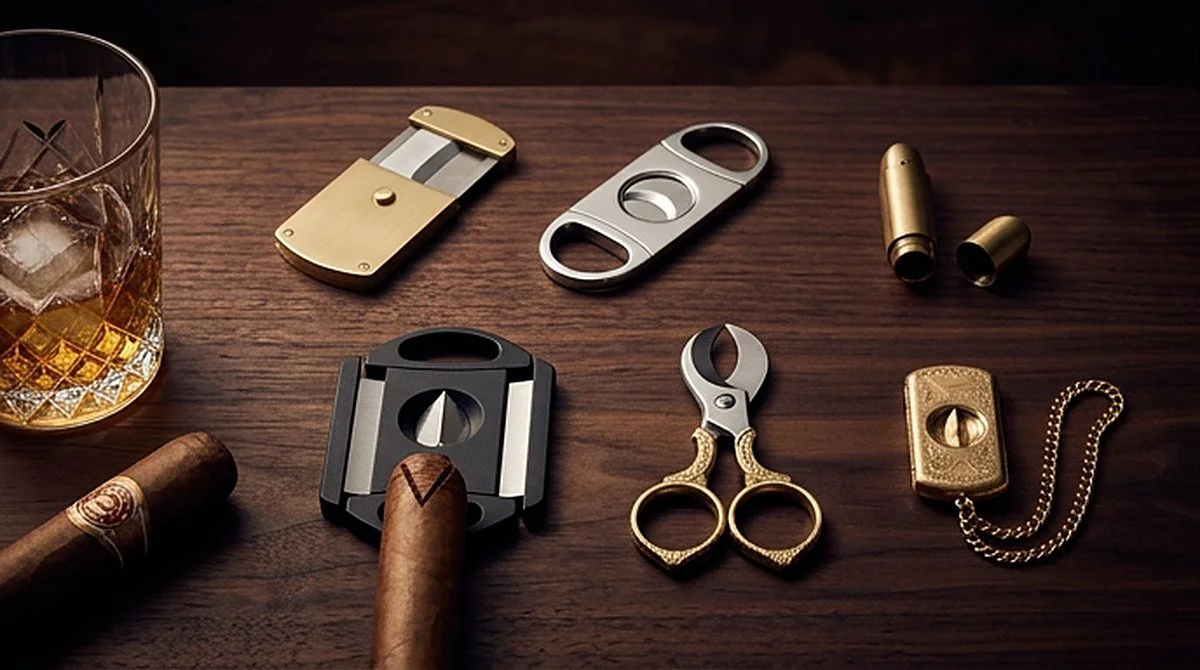
Single Guillotine
No. 01- Look for
- A flat body, a round opening, and one straight blade
- How it cuts
- Push the blade across in one quick motion
- Notes
- Cheap, easy to carry, works on almost anything. A dull blade can pinch or tear. Suits the everyday pocket and a first cutter.
Double Guillotine
No. 02- Look for
- Two blades closing from opposite sides, worked with thumb and finger
- How it cuts
- Held steady from both sides, so the cut comes clean
- Notes
- Handles round heads and pointed ones, thin and thick. If you only own one cutter, own this one.
Punch
No. 03- Look for
- A small round blade, often shaped like a bullet
- How it cuts
- Press it into the cap and twist out a neat plug
- Notes
- Keeps the head tidy and the wrapper safe. A tighter draw. Not for pointed heads. Lives on a keyring.
V-Cut
No. 04- Look for
- A wedge-shaped blade, also called a cat’s eye
- How it cuts
- Leaves a deep notch across the head
- Notes
- Shines on thick, rounded cigars for a full, open draw. A dull one crushes, so quality shows here.
Scissors
No. 05- Look for
- Short, curved blades on scissor handles
- How it cuts
- Wrap the head and close in one smooth, firm motion
- Notes
- In practiced hands, one of the cleanest cuts there is, any size or shape. Not a pocket tool. Belongs on the desk.
How to spot a good one
The blade. Stainless steel holds its edge and resists the sticky resin cigars leave behind. The action. It should close with a clean snap, blades meeting fully, no wobble. The weight. Brass, steel, or gunmetal feels steadier than plastic and lasts long enough to hand down. The finish. Match it to his lighter, his watch, or his bar.
Most men end up with two: one to carry and one that stays home.
Common Questions
What's the best cigar cutter for a beginner?
A double guillotine. It works on round and pointed heads, thin and thick cigars, and it's hard to get wrong. If he only owns one cutter, this should be it.
Punch cutter or guillotine: which is better?
Neither is better. They give a different draw. A punch makes a small round hole for a tighter draw and keeps the head tidy, but it won't work on pointed cigars. A guillotine takes off the whole cap for a fuller, more open draw and works on almost anything.
How much of the cigar should I cut off?
Very little, usually just a sliver of the cap. Find the faint line where the cap meets the wrapper and stay above it. Cut too deep and the wrapper can unravel. You can always take more, but you can't put it back.
Why does my cigar unravel after I cut it?
Usually it's a dull blade or a cut that went below the cap line. A dull blade crushes and tears instead of slicing. Cut quickly and firmly, never slow and sawing, and keep the blade clean of resin.
Can I cut a cigar without a cutter?
In a pinch, a very sharp knife on a clean surface will do. Make one quick, straight cut just above the cap line. Skip your teeth. It tears the wrapper and spoils the draw.
THE SOCIETY’S GIFTING NOTES
For the one who’s earned it.
TIER 1
Under $50
A solid punch for his pocket, or a sharp stainless single guillotine for the glove box.
Our pick: XIKAR 10mm Punch
TIER 2
$50 to $150
A well-made double guillotine he’ll carry for years. It works on any cigar, so you don’t need to know what he smokes.
Our pick: XIKAR Xi1
TIER 3
$150 and up
A cutter made to be kept: Damascus steel and the kind of weight you notice. The one he’ll hand down.
Our pick: XIKAR Xi3 Damascus
How to give it: put a good cigar in the box with it, already picked out, so the first cut happens the night he opens it.
