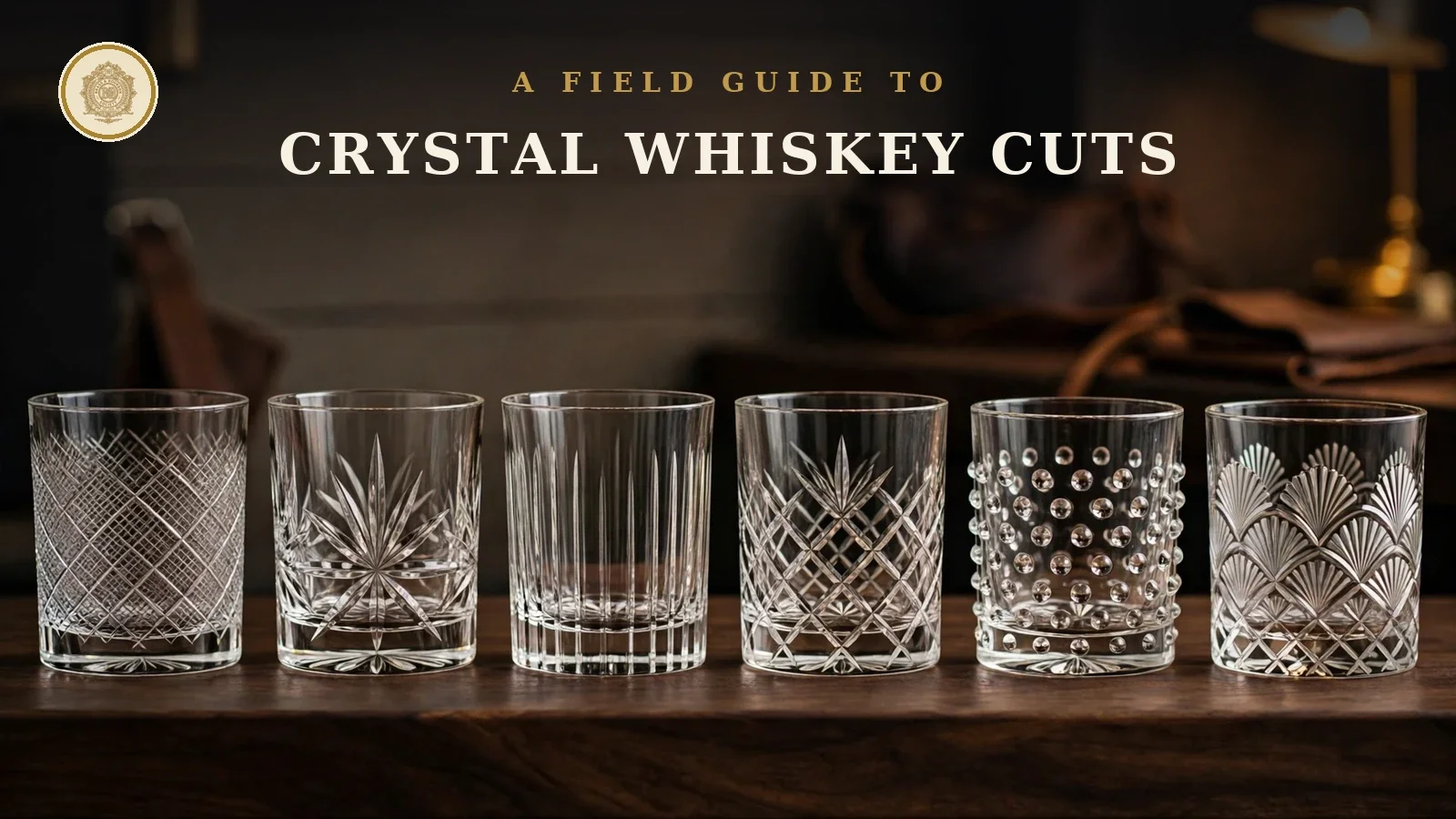
FIELD NOTES — ENTRY NO. 01
This guide may contain affiliate links. If you buy through one, we may earn a small commission at no extra cost to you. As an Amazon Associate I earn from qualifying purchases. We only recommend the kinds of things we’d keep ourselves.
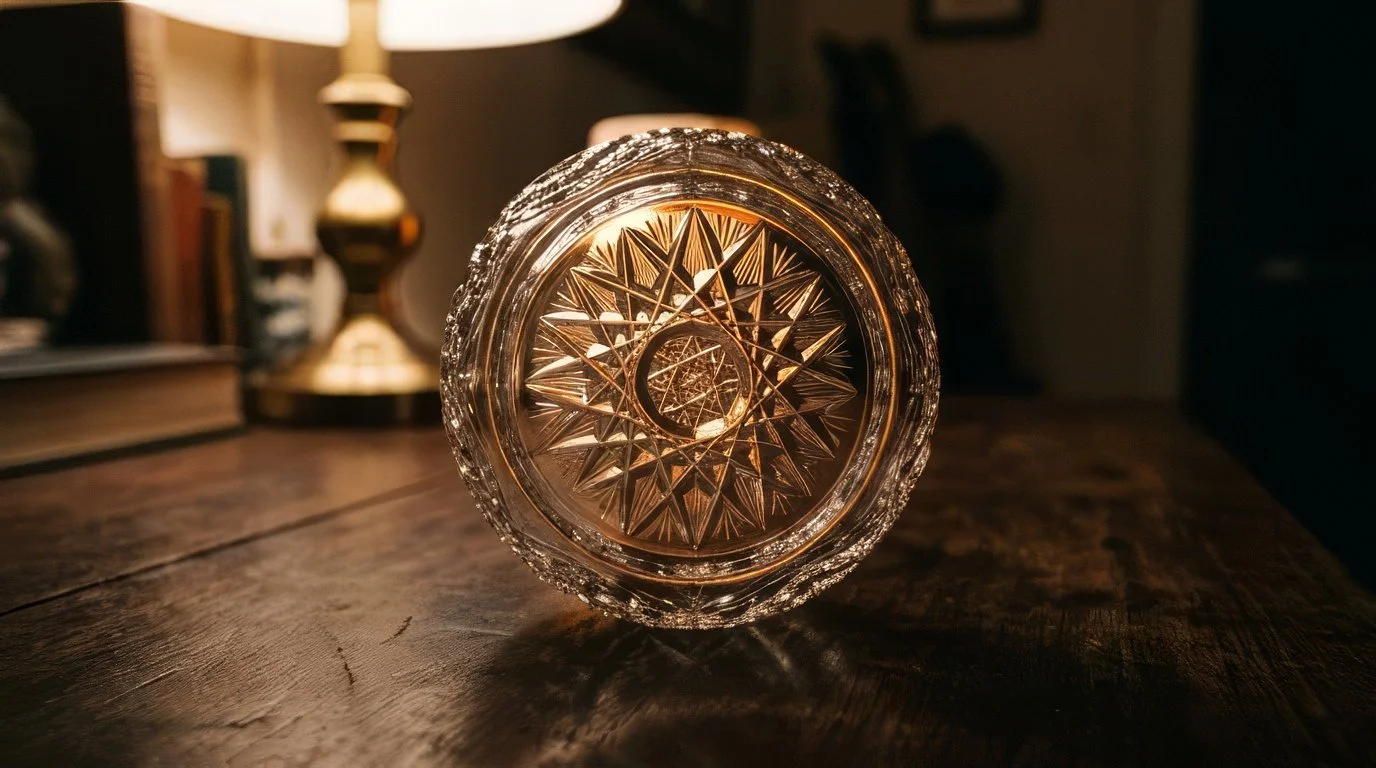
Pick up a good rocks glass and your hand notices it before your mouth does. The weight. The cool edge. The way the porch light catches in the cuts.
Somebody made that. Maybe a cutter bent over a wheel a hundred years ago, maybe a mold in a factory last spring. Either way, there’s a pattern there with a name and a history, and most of us have never been told what it is.
So let’s fix that.
Where these patterns come from
Lead crystal was born in England in the 1670s, when glassmakers found that adding lead to the glass made it clearer, heavier and softer to cut. By the late 1700s, cutters in England and Ireland had turned it into an art, and American shops picked it up and ran with it. Between about 1876 and 1916, a stretch collectors call the Brilliant Period, American cut glass hit its peak. Some patterns ran so deep that a single piece could take a cutter days to finish by hand.
Most glasses on the shelf today still borrow from that era. Same patterns, same names, even when the way they’re made has changed.
Brilliant Period: roughly 1876 to 1916. If a dealer says “ABP,” that’s American Brilliant Period.
Lead is what gives crystal its weight and its ring when you tap it.
Cut or pressed? A field comparison
| Trait | Hand-cut | Pressed or molded |
|---|---|---|
| How it’s made | Ground one line at a time on a spinning wheel | Poured into a mold with the pattern built in |
| Edges | Crisp, almost sharp | Softer, rounded over |
| In the hand | Usually heavier | Usually a touch lighter |
| Every one alike? | No, small differences in every cut | Yes, perfectly even |
| Price | Higher | More affordable |
The thumb test: run your thumb along the pattern. If it feels crisp, it’s likely cut. Neither one is lesser; they just do different jobs.
The specimens
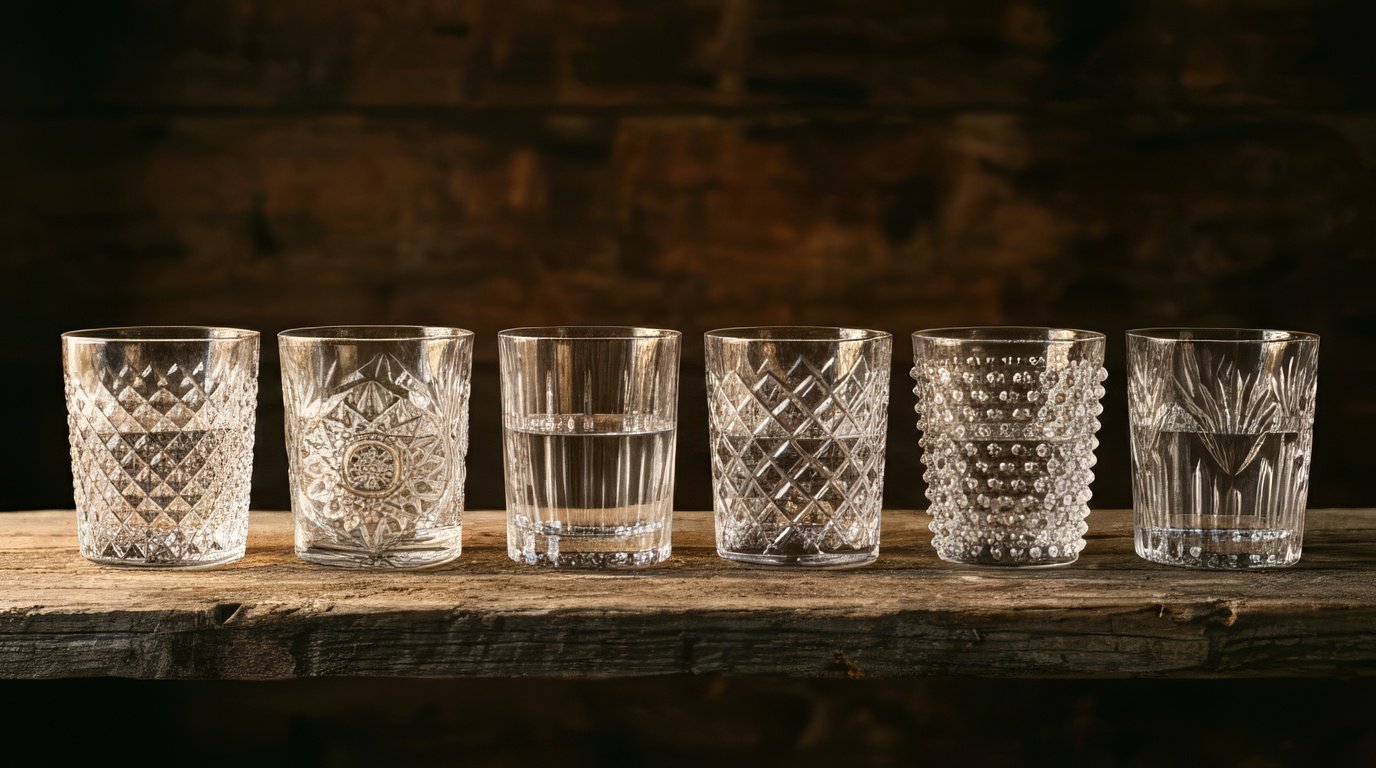
Strawberry Diamond
No. 01- Look for
- Tiny diamonds packed close together across the surface
- In the hand
- Fine texture, sparkle spread across the whole glass
- Notes
- One of the oldest cut-glass patterns, named for the seeds on a strawberry. Almost always paired with a bigger motif.
Hobstar
No. 02- Look for
- A many-pointed star bursting from one center, often on the base
- In the hand
- Bold, usually framed by other cuts
- Notes
- The workhorse of traditional cut glass. Look for the small flat “hob” right in the middle.
Flute
No. 03- Look for
- Straight, even grooves running top to bottom
- In the hand
- Smooth ridges and an easy grip
- Notes
- The quietest pattern here, and one of the oldest. Clean enough to look modern.
Diamond Cut
No. 04- Look for
- Crossed lines forming rows of raised diamond points
- In the hand
- Crisp, bold, geometric
- Notes
- What most people picture when they hear “cut crystal.” The skeleton other patterns get built on.
Hobnail
No. 05- Look for
- Rows of small, rounded bumps
- In the hand
- Soft, knobby, great grip
- Notes
- Usually molded, not cut, which is why it’s easy to find and easy on the wallet. Collectors also use the word for the center of a hobstar.
Fan Cut
No. 06- Look for
- Scalloped fan shapes, usually near the rim
- In the hand
- A little texture right at the lip
- Notes
- Used like punctuation: a border, a flourish between two hobstars.
A word on names
Pattern names were never fully standardized. Two shops in the same decade might call the same cut two different things, and dealers today still go by what they see. Don’t sweat the vocabulary. Just start looking closer at what’s in your hand.
Common Questions
What's the difference between crystal and regular glass?
Crystal has minerals added to the glass, traditionally lead oxide, and today often barium or zinc in lead-free crystal. That makes it clearer, heavier, and easier to cut deeply, which is where the sparkle comes from. Tap the rim of a crystal glass and it rings like a bell. Regular glass gives a dull clink.
How can I tell if a glass is hand-cut or pressed?
Run your thumb over the pattern. Hand-cut edges feel crisp, while pressed (molded) glass feels rounded and soft. Hand cuts also vary slightly from one to the next, where a mold repeats perfectly. Both make good glasses. Hand-cut just costs more.
Is it safe to drink whiskey from lead crystal?
For pouring a drink and enjoying it, lead crystal is generally considered fine. The usual advice is not to store whiskey in a lead crystal decanter for weeks or months, because lead can slowly leach into the spirit over time. Pour it, drink it, and keep the bottle as your storage.
Can crystal glasses go in the dishwasher?
Hand wash them. Dishwasher heat and detergent can cloud and etch crystal over time, especially lead crystal. Warm water, a little mild soap, and a soft towel will keep them clear for decades.
Which crystal pattern makes the best rocks glass?
It comes down to taste. Deep cuts like hobstar and diamond catch the most light and give your hand something to hold. A plain flute cut is cleaner and more understated. If it's a gift, match the patterns he already has on his bar.
THE SOCIETY’S GIFTING NOTES
For the one who’s earned it.
TIER 1
Under $50
A set of pressed hobnail rocks glasses. Heavy, easy to love, and good for everyday pours.
Our pick: a heavy pressed hobnail set of four
TIER 2
$50 to $150
A cut diamond or hobstar set. You’ll feel the difference the first time you pick one up.
TIER 3
$150 and up
A pair of Waterford Lismore, the pattern people know on sight. Good crystal gets handed down, and this is where that starts.
How to give it: don’t just wrap the glass. Pour the first one yourself, hand it over, and tell them which pattern they’re holding.
