FIELD NOTES — ENTRY NO. 05
This guide may contain affiliate links. If you buy through one, we may earn a small commission at no extra cost to you. As an Amazon Associate I earn from qualifying purchases. We only recommend the kinds of things we’d keep ourselves.
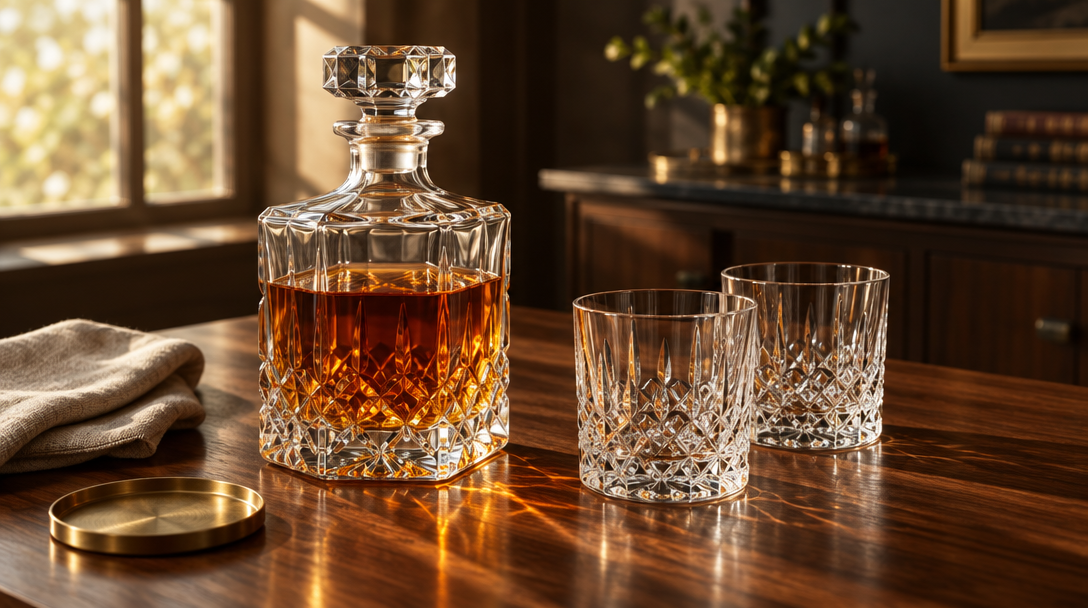
A decanter doesn’t make whiskey taste better. Let’s get that out of the way. What it does is harder to measure: it turns a bottle with a label into something that sits on the bar like it belongs there, and it makes the first pour of the evening feel like an occasion.
That’s not nothing. Most of the evening ritual is about slowing down, and a decanter is a small, heavy reason to do exactly that. You lift the stopper, you pour, you set it back. Nobody rushes a decanter.
So here’s what’s worth knowing before you buy one, or before you pour from the one that’s been in the family for years.
Where the decanter comes from
Decanting started as a wine job. Old wine throws sediment, and pouring it slowly into a clean vessel left the grit behind in the bottle. Glass decanters took off in 18th-century England, right after glassmakers learned to make clear, heavy lead crystal, and they quickly became a sign of a well-kept house.
Whiskey has no sediment to leave behind, and unlike wine it doesn’t change much with air. So for spirits, the decanter is mostly about presentation, and about the ritual of the pour.
One favorite piece of history: the Victorians locked their decanters in a stand called a tantalus, so the household staff could see the whiskey but couldn’t reach it. It was named after Tantalus of Greek myth, who stood forever just out of reach of food and drink.
Does a decanter improve whiskey?
No, and that’s fine. Whiskey is already finished when it’s bottled. A few minutes of air in the glass can open up the aroma a little, but you’ll get that from the glass itself. A decanter won’t smooth out a harsh pour or age a young one.
What matters is the stopper. A snug, well-ground stopper keeps the whiskey close to how it was bottled for months. A loose one lets alcohol and aroma slowly escape, and after a few weeks the whiskey can taste flat. Tip a full decanter gently over the sink: if it weeps at the stopper, it’s for serving, not storing.
Lead crystal is the one real caution. Lead can slowly move from the glass into spirits stored in it for weeks or months. Use lead crystal for serving on the night, and store whiskey long-term in the bottle or in lead-free crystal.
Crystal, lead-free or glass?
| Trait | Lead crystal | Lead-free crystal | Glass |
|---|---|---|---|
| Sparkle | Brilliant, deep cuts | Nearly as bright | Clear, plainer |
| In the hand | Heaviest | Heavy | Lighter |
| Storing whiskey | Serve only; don’t store long | Fine for months | Fine for months |
| Care | Hand wash only | Hand wash best | Easiest |
| Price | Highest | Middle | Lowest |
Vintage decanters are almost always lead crystal. They’re beautiful on the bar; just empty them back into the bottle at the end of the night.
The specimens
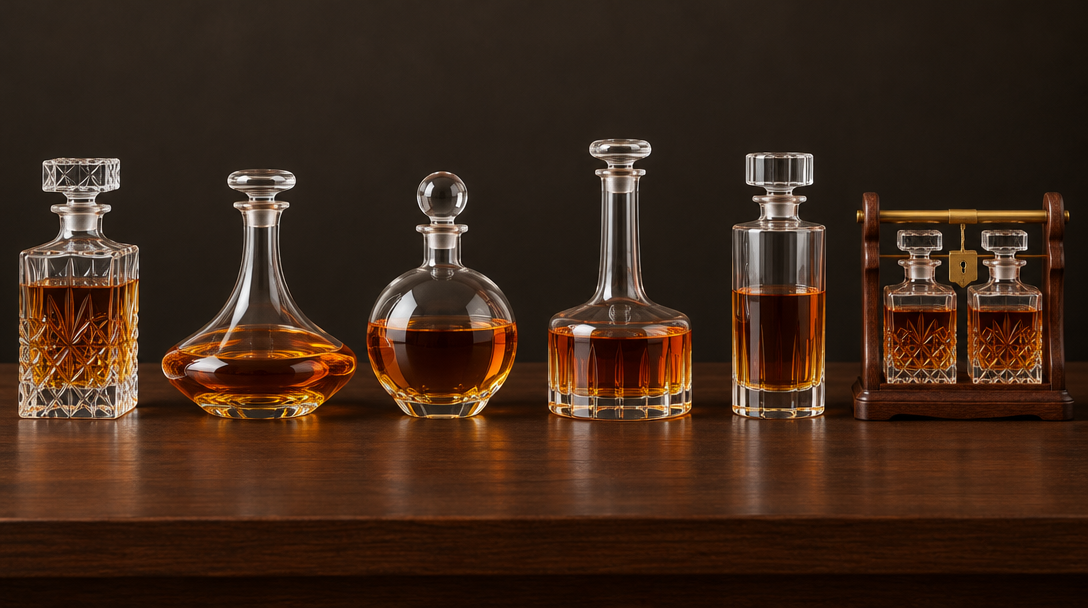
Square
No. 01- Look for
- Straight, heavy sides and a faceted stopper
- On the bar
- Sits squarely on a tray and packs neatly beside others
- Notes
- The study-and-library classic, and the shape most often cut in crystal.
Ship’s Decanter
No. 02- Look for
- A very wide, flat base rising to a narrow neck
- On the bar
- Almost impossible to knock over
- Notes
- Built for the tables of rolling ships. Old versions are sometimes called Rodney decanters, after a British admiral.
Globe
No. 03- Look for
- A round body, often etched with a map, set in a wooden stand
- On the bar
- A conversation piece more than a workhorse
- Notes
- Usually glass, not crystal. Check the stopper fit before you trust it for storage.
Mallet
No. 04- Look for
- Sides that slope out to a wide base, like a mallet head
- On the bar
- Steady and handsome, with an old-world outline
- Notes
- A Georgian English shape, and a favorite with antique dealers.
Cylinder
No. 05- Look for
- Tall, straight sides, often plain glass with a wood or metal stopper
- On the bar
- Clean and modern; shows off the color of the whiskey
- Notes
- The easiest to clean and the easiest to find lead-free.
Tantalus
No. 06- Look for
- Two or three square decanters held in a locking wooden or brass frame
- On the bar
- A whole bar in one piece of furniture
- Notes
- Not a decanter but a stand for them. Victorian ones turn up at estate sales, often with a key.
Care and keeping
Rinse with warm water only. Soap leaves a film you’ll taste, and the dishwasher can cloud crystal for good. For a stubborn ring, swirl a spoonful of uncooked rice with warm water, then rinse.
Dry it upside down with the stopper out, and store an empty decanter unstoppered so it doesn’t trap moisture and go musty.
Common Questions
Does a decanter improve whiskey?
No. Whiskey is finished when it's bottled, and unlike wine it doesn't change much with air. A decanter is about presentation and the ritual of the pour. A few minutes in the glass can open up the aroma a little, but the decanter itself won't smooth or age it.
How long can whiskey stay in a decanter?
In a glass or lead-free crystal decanter with a snug, well-ground stopper, whiskey keeps for months. A loose stopper lets alcohol and aroma escape, and after a few weeks the whiskey can taste flat. Tip a full decanter gently over the sink: if it weeps at the stopper, use it for serving, not storing.
Is it safe to store whiskey in a lead crystal decanter?
Serving from lead crystal on the night is fine, but don't store whiskey in it for weeks or months, because lead can slowly move into the spirit. Pour it back into the bottle at the end of the evening, or use glass or lead-free crystal for keeping.
What is a tantalus?
A tantalus is a locking stand that holds two or three square decanters. Victorians used them so household staff could see the whiskey but couldn't reach it. The name comes from Tantalus of Greek myth, who stood forever just out of reach of food and drink.
How do you clean a decanter?
Rinse it with warm water only. Soap can leave a film you'll taste, and the dishwasher can cloud crystal for good. For a stubborn ring, swirl a spoonful of uncooked rice with warm water, then rinse, dry it upside down, and store it empty with the stopper out.
THE SOCIETY’S GIFTING NOTES
For the one who hosts.
TIER 1
Under $50
A heavy glass decanter with an airtight stopper. Handsome, and fine for keeping whiskey in.
Our pick: Bormioli Rocco Selecta decanter
TIER 2
$50 to $150
A lead-free crystal decanter with a matched pair of rocks glasses. Everything he needs to pour for a friend.
Our pick: Lion Head lead-free crystal decanter set
TIER 3
$150 and up
A cut crystal decanter from a name he’ll recognize, or a vintage mallet from an antique dealer. Pour from it; store in the bottle.
Our pick: Marquis by Waterford Moments decanter
