FIELD NOTES — ENTRY NO. 07
This guide may contain affiliate links. If you buy through one, we may earn a small commission at no extra cost to you. As an Amazon Associate I earn from qualifying purchases. We only recommend the kinds of things we’d keep ourselves.
The wrapper is the first thing you see and the first thing you taste. It’s the single outer leaf rolled around the cigar, and it carries a big share of the flavor and aroma.
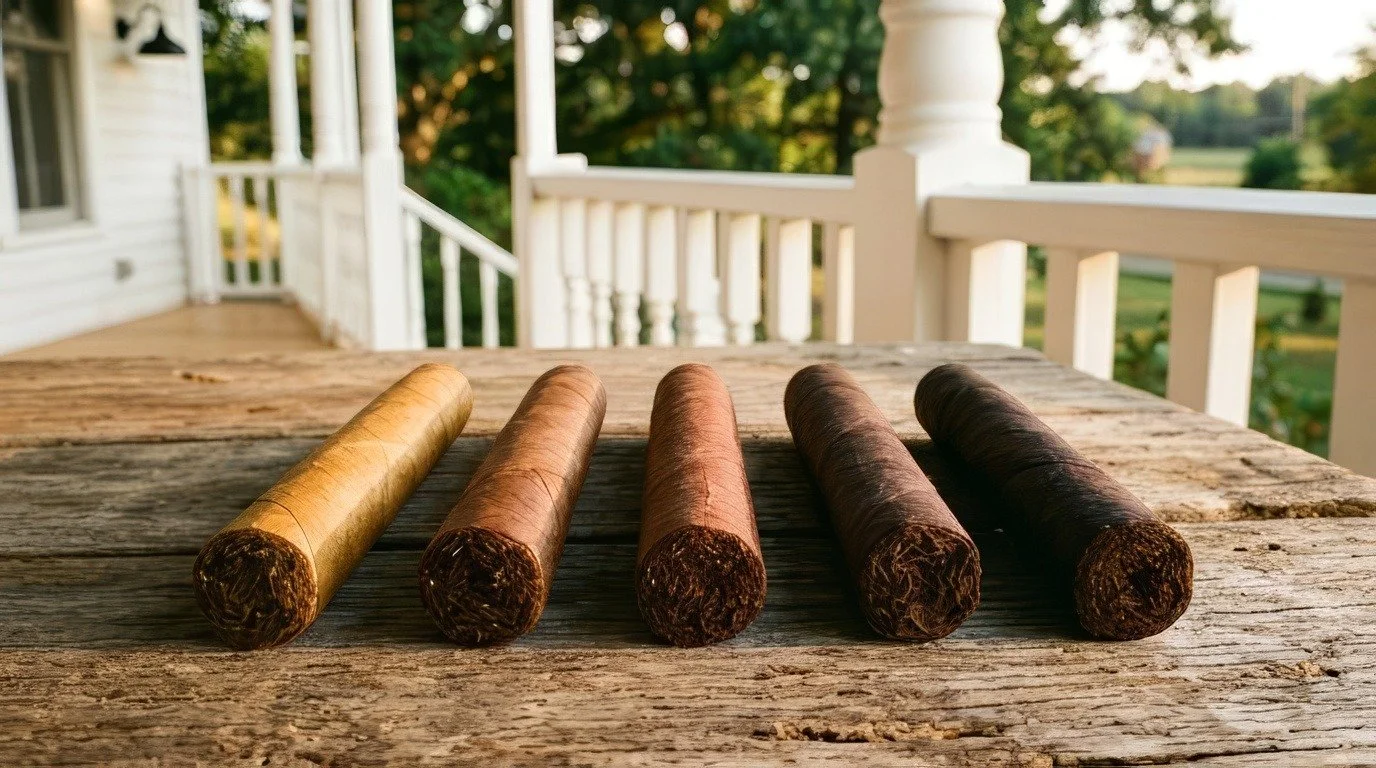
Its color comes mostly from where the leaf grew, how much sun it saw, and how long it was fermented. Here are the seven classic shades, lightest to darkest, and what each one tends to taste like.
The specimens
Candela
No. 01- Look for
- Pale green, also called Double Claro
- How it’s made
- Picked early and dried quickly with heat to keep its chlorophyll
- Tastes
- Light and grassy, sometimes a little sweet. Popular in America decades ago, now mostly a nod to the old days.
Claro
No. 02- Look for
- Light golden tan, like a paper grocery bag
- How it’s made
- Often Connecticut Shade, grown under cheesecloth tents that keep the leaf thin and silky; the shortest fermentation
- Tastes
- Mild, smooth and creamy. A good place for a new smoker to start.
Colorado Claro
No. 03- Look for
- A light tawny brown, a shade darker than Claro
- How it’s made
- Fermented a little longer than Claro
- Tastes
- Mellow, with a touch more flavor. Many cigars sold as “natural” sit right around here.
Colorado
No. 04- Look for
- Medium brown with a reddish, often oily sheen
- How it’s made
- Often a sun-grown leaf such as Habano or Corojo. “Colorado” is Spanish for “colored red”
- Tastes
- More spice, cedar and body. A deeper, brick-red version is sometimes called Rosado.
Colorado Maduro
No. 05- Look for
- A dark, chocolatey brown
- How it’s made
- Fermented longer than Colorado, short of a full Maduro
- Tastes
- Keeps some of Colorado’s spice and adds a little of Maduro’s richness.
Maduro
No. 06- Look for
- Dark, rich brown. “Maduro” means “ripe”
- How it’s made
- Fermented far longer in large piles that build their own heat; only thick, sturdy leaves survive. Common leaves include Connecticut Broadleaf, Mexican San Andrés and Brazilian
- Tastes
- Cocoa, coffee, molasses and a natural sweetness.
Oscuro
No. 07- Look for
- The darkest shade, nearly black; once called “double Maduro”
- How it’s made
- Usually from the top leaves of the plant, which get the most sun
- Tastes
- Bold, earthy and heavy, with dark chocolate, espresso and pepper.
Darker doesn’t mean stronger
This is the biggest myth about wrapper color. A cigar’s strength comes mostly from the filler and binder inside, not the wrapper on the outside. A dark Maduro can be mild and sweet, and a pale Claro can hide a strong blend.
Color tells you about flavor, not about kick. The exception is Oscuro, which is often stronger because of the leaves it’s made from.
No two shops agree
There’s no official color chart, and every maker and shop uses these names a little differently. One brand’s Colorado Claro is another’s Natural. Use the shades as a rough map, and trust your own palate over the label.
Pairing by shade
A simple rule of thumb: match light with light and dark with dark. A Claro sits well with a softer bourbon, a wheated one, or a morning coffee. A Colorado stands up to a spicy rye. A Maduro or Oscuro wants something with weight, like a high-proof bourbon, a peated Scotch or a glass of port.
Common Questions
What’s the difference between a Natural and a Maduro cigar?
Natural is a loose term for the lighter-to-medium shades, usually Claro through Colorado. Maduro is a dark wrapper fermented much longer, which makes it richer and sweeter.
Are Maduro cigars stronger?
Not necessarily. Strength comes mostly from the filler and binder. Maduro is about richness and sweetness, not nicotine.
Which wrapper is best for a beginner?
A Claro, like a Connecticut Shade, is the gentlest place to start. Smooth, mild and creamy.
Why do some cigars have a white powder on the wrapper?
That’s often plume, natural oils that crystallize on a well-aged cigar and brush off easily. Fuzzy, blue or green spots are mold, and that’s another story. Our Humidor Basics field guide covers how to tell them apart.
Cigars are for adults only. In the U.S., you must be 21 to buy tobacco products.
THE SOCIETY’S GIFTING NOTES
For the one learning his shades.
TIER 1
Under $25
A tasting journal with a flavor wheel, for keeping track of every shade he tries and which ones he’d buy again.
Our pick: Cigar tasting journal
TIER 2
$25 to $75
Nearly two pounds of antique brass with four rests, made to live on the porch table.
Our pick: Visol heavyweight antique brass ashtray
TIER 3
$75 and up
A steady, wind-resistant triple-jet flame for toasting any wrapper evenly.
Our pick: XIKAR HP3 triple-jet lighter
From our partners
Try a cigar sampler at Famous Smoke →