FIELD NOTES — LEATHER & WOOD
This guide may contain affiliate links. If you buy through one, we may earn a small commission at no extra cost to you. As an Amazon Associate I earn from qualifying purchases. We only recommend the kinds of things we’d keep ourselves.
Few things are as personal as a good pocket knife. It opens boxes, trims string and, in a pinch, clips a cigar.
Many get carried for decades and handed down for generations. Here’s how to tell them apart, and how to choose one worth keeping.
How it opens and locks
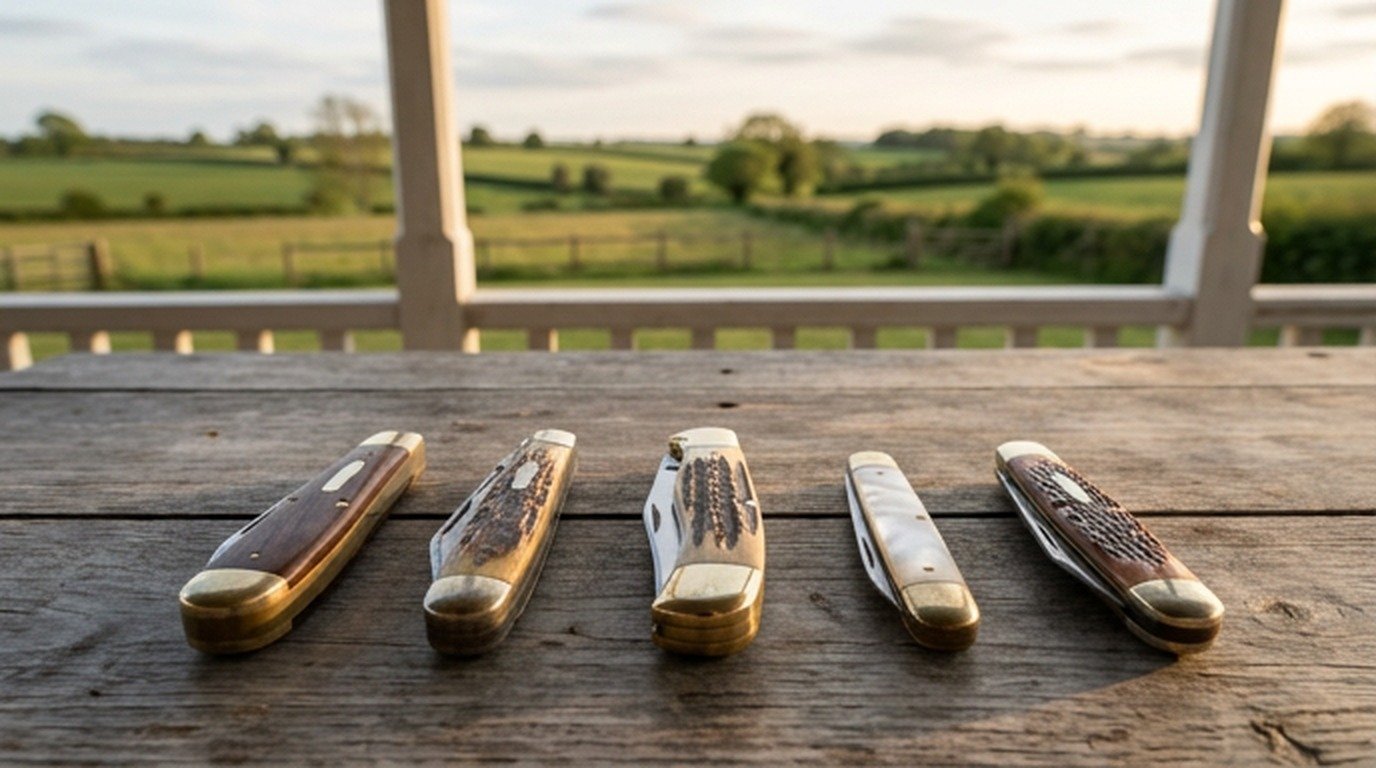
Slip joint. The classic grandfather’s knife. A spring holds the blade open, but there’s no lock, so it can close if you push the wrong way. Traditional patterns include the Trapper, with two long blades, and the Stockman, with three blades of different shapes.
Lockback. A lock on the spine holds the blade firmly open. Press the back of the handle to release it.
Liner lock. A thin strip of metal inside the handle springs in behind the blade to lock it. It’s easy to close with one hand.
Frame lock. Like a liner lock, but a section of the handle itself does the locking. It’s sturdy and modern.
Blade shapes
Drop point: a gently curved spine that runs down to the tip. Strong and all-purpose.
Clip point: the spine dips to a fine, sharp tip. It’s the classic Bowie look, and good for detail work.
Sheepsfoot: a straight edge with a rounded-off tip, for controlled cutting without poking.
Handles and steel
Wood, stag and jigged bone age warmly and wear to the shape of a hand. Nickel silver or brass bolsters add weight and shine. Synthetic handles and Micarta are tough and nearly carefree.
Blades come in two main kinds. Stainless resists rust and asks little of you. Carbon steel, like chrome vanadium, takes a keen edge and sharpens easily, but it will darken and can spot if it’s left wet.
Keep a carbon blade dry and give it a drop of oil now and then. The gray patina it builds is normal, and many owners love it.
Before you carry
Knife laws vary by state and city, especially on blade length and locking blades. Check your local rules before you carry, and leave the knife home when you fly.
How to give it
There’s an old superstition that a knife given as a gift can cut the friendship. The fix is to make it a sale: tuck a penny in the box, and he hands it back to you. Add a note that says, “For every job, large and small.”
Common Questions
What is a slip-joint knife?
A traditional folding knife held open by a spring, with no lock. Trappers and Stockmans are classic slip-joint patterns.
What’s the difference between a Trapper and a Stockman?
A Trapper usually has two long blades, a clip and a spey, that open from the same end. A Stockman has three blades of different shapes, usually a clip, a sheepsfoot and a spey or pen blade.
Is carbon steel or stainless better for a pocket knife?
Stainless is easier to care for. Carbon steel takes and holds a keen edge and sharpens easily, but it needs to be kept dry and will darken over time.
Is it bad luck to give a knife as a gift?
By old superstition, a gifted knife can cut the friendship. Tuck a coin in the box so he can “pay” for it, and the luck is fixed.
Can I carry a pocket knife anywhere?
No. Knife laws vary by state and city, and knives aren’t allowed in airplane carry-ons. Check your local rules first.
THE SOCIETY’S GIFTING NOTES
For the man who’s always prepared.
TIER 1
A fine gesture
Three classic folding knives in a gift tin: one for his pocket, one for the truck, one for the junk drawer.
Our pick: Old Timer three-knife gift set in a tin
TIER 2
The proper gift
The Trapper, one of the great American patterns, with two long blades and a bright yellow handle that’s easy to find in a toolbox.
Our pick: Case Yellow Synthetic Trapper
TIER 3
The heirloom
A three-blade Stockman with a jigged amber bone handle, made in the USA. The kind of knife that gets handed down.
Our pick: Case Amber Bone Medium Stockman
Our hand-picked list for this guide, gathered on our Amazon storefront. We may earn a small commission when you buy through it.
